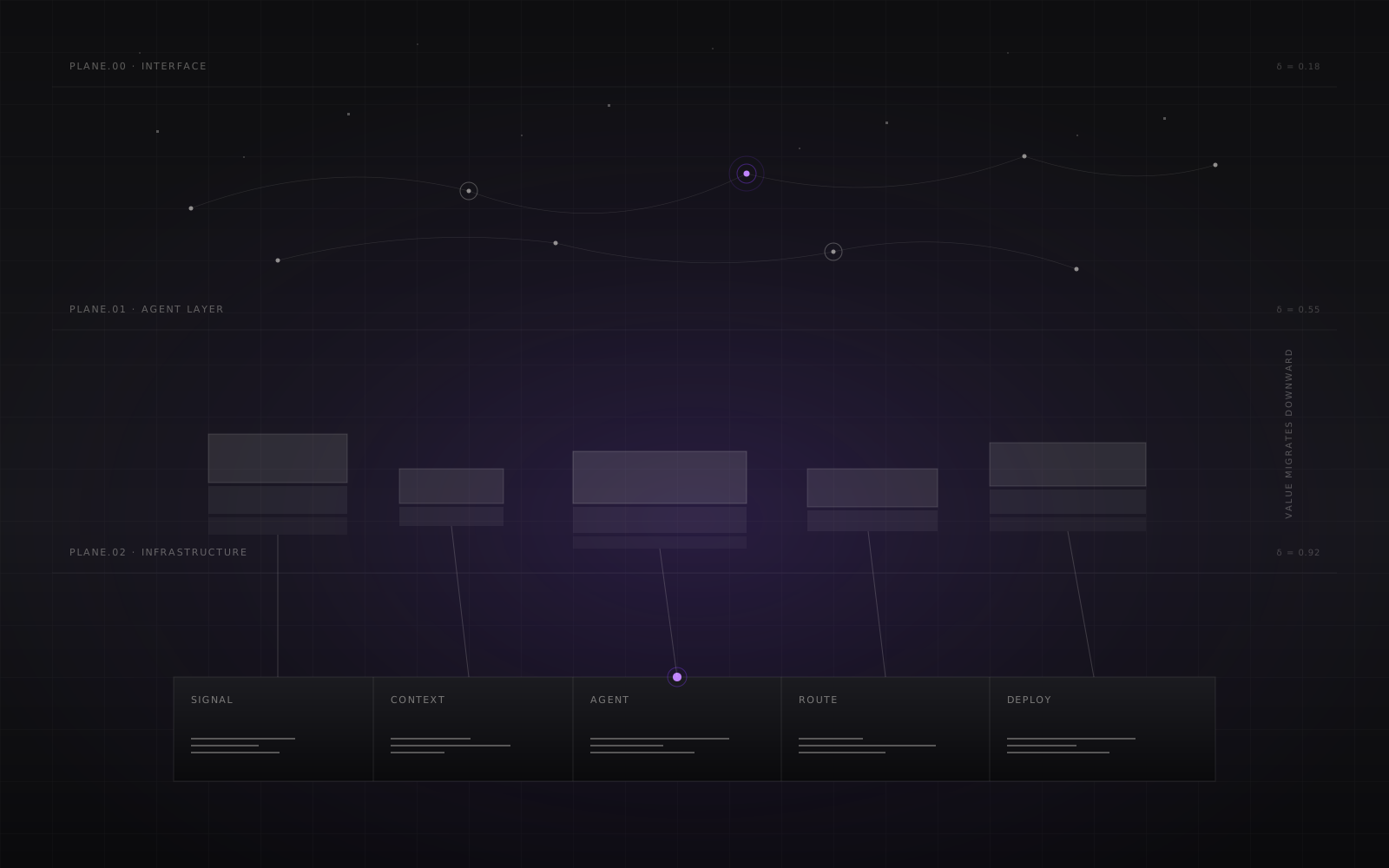
For two decades, the SaaS playbook was a contract between buyer and interface. You bought seats; users logged in; the product earned its place by being the screen the work happened on. The interface was the product. Pricing, packaging, sales motion, content engine, success metrics — all of them organized around getting more humans into more screens for more hours.
That contract is dissolving. The work is migrating off the screen and into agents. Account research now happens in a conversation an SDR never sees. Demo composition happens before a human reads the inbound. Pricing math happens inside the buyer's procurement agent, not the buyer's spreadsheet. The seat — the unit the whole SaaS economy was priced against — is no longer the unit of work.
This is what we mean by Headless GTM: the structural redesign of the motion that follows when the interface is no longer the deliverable. The work still gets done. The value still gets delivered. But the surface area on which it happens has moved.
The bolt-on pathWhat most teams are doing right now.
The first response to AI inside most B2B teams looks the same. Add a copilot. Wire a model into the existing motion. Keep the org chart, keep the tool stack, keep the pricing model, keep the sales motion — and patch in an assistant somewhere near the user. The board approves it. The line item is small. The motion still feels familiar.
This is the bolt-on path. It is structurally insufficient. It treats AI as a feature inside the current motion when AI is the force that makes the current motion obsolete. The copilot accelerates a workflow whose deeper structure — per-seat pricing, demo-driven evaluation, volume-first content production — was tuned for a buyer that no longer exists.
A copilot on top of a motion designed for the human-as-operator is a faster version of the wrong thing. The wrong thing being faster does not make it right.
The bolt-on path produces predictable failure modes. The quarter-by-quarter erosion as machine customers route around the UI. The pricing model that under-collects against a workload that has gotten 10× heavier. The content engine producing assets that no agent retrieves. The sales motion stuck demoing software to buyers who already ran the agent before the call was booked.
The headless redesignWhat a motion designed for the agent layer looks like.
The headless redesign starts from a different question. Not "where do we add AI to the current motion?" but "what does the motion look like if the agent layer is the primary interface and the human surface is the exception?"
That question reorganizes everything downstream. Tool stack. Pricing model. Content engine. Sales motion. Each of them gets re-asked from scratch:
- The tool stack collapses. Twelve point solutions licensed for seat-bound humans become a small number of composable platforms with agents stitching between them.
- Pricing converts from per-seat to consumption or outcome. The unit of billing is the unit of value, which is no longer a login.
- Content becomes agent-ready. Thesis-driven, retrieval-optimized, indexed by structure rather than by SEO keyword. The asset earns its place by being what an agent reaches for.
- The sales motion shifts from demo-driven evaluation to integration-driven evaluation. Buyers compose the system inside their own environment before they buy it.
- The success metric for the GTM team stops being seats sold and starts being workloads absorbed.
Value migrates downward into infrastructure while the interface above evaporates.
Six structural movesThe work, sequenced.
A headless GTM redesign is not a single intervention. It is a sequence of six structural moves, each of which can be scoped, dated, and shipped inside an engagement. They compound — earlier moves make later moves cheaper — and they are reversible. Every gate has a revert path.
Move 01 — Motion audit and structural diagnosis
Map the motion that exists, end-to-end. Name the bolt-on patterns that are propping it up. Identify the highest-leverage move to retire first. Output is a written audit, not a deck.
Move 02 — Tool-stack collapse
Catalog every tool against the workload it actually carries. Retire the duplicates. Consolidate to the smallest set of platforms that survive the agent layer. Most engagements collapse 12 tools to 4.
Move 03 — Pricing-model conversion
The hardest move to sequence and the one most likely to be deferred. Per-seat to consumption or outcome. Done with one cohort first, then propagated. We have a separate brief on this — read it if you are sitting on this move.
Move 04 — Content-engine rebuild
The content asset becomes a structural input to retrieval, not a marketing softener at the top of the funnel. Thesis-driven pieces — like the one you are reading — indexed for what agents will reach for.
Move 05 — Agent surface deployment
The actual agents — inbound triage, account research, demo composition, pricing math, content retrieval. Shipped as production code into your environment, with skill files versioned alongside your repo and evaluation harnesses that survive model-layer drift.
Move 06 — Operate, learn, hand back
The system compounds. Weekly refinement. Monthly evaluation. Quarterly architecture review. The engagement ends when your team's velocity outpaces what we add. That is the exit criterion, written into the SOW.
The buyer that does not exist yetWhat we are designing for.
The buyer this motion is designed for is not the one we have seen for two decades. The buyer evaluates by integration, not by demo. The buyer's procurement agent does the pricing math the buyer used to do. The buyer's success criteria is the workload absorbed, not the seats deployed. The buyer reads briefs like this one because the buyer is also operating under the same migration of work off the screen.
The teams that win the next cycle are the teams that redesign for that buyer now, before the bolt-on path runs out of margin. The bolt-on motion has a year, maybe two. The structural redesign has a decade.
If the motion you operate inside is in the $5M–$100M ARR range and you can feel the bolt-on path running thin, that is the conversation to have.